Data Table
The Data Table tab displays dataset contents in tabular format, allowing you to explore data using filters and sorting.
See also Getting Started.
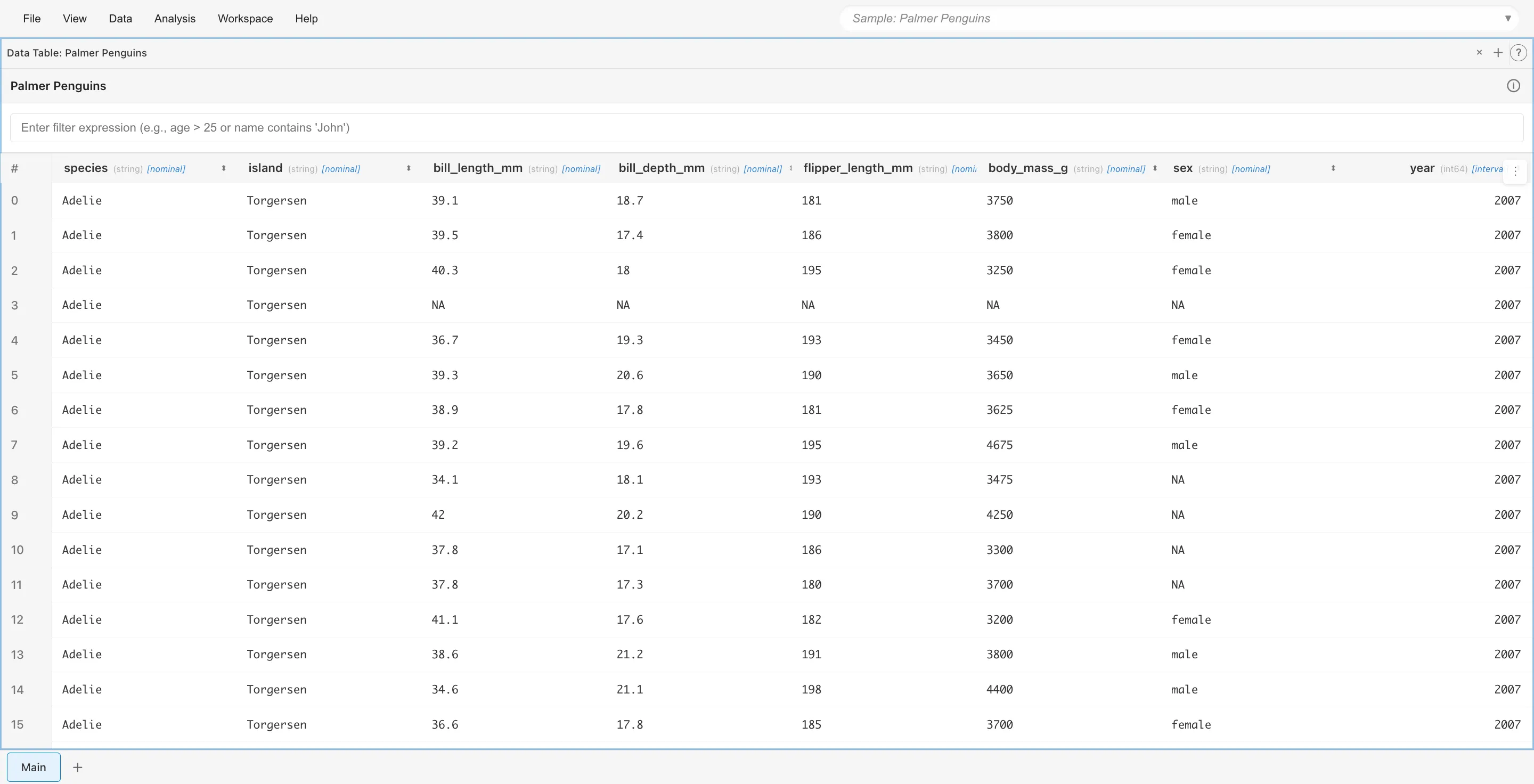
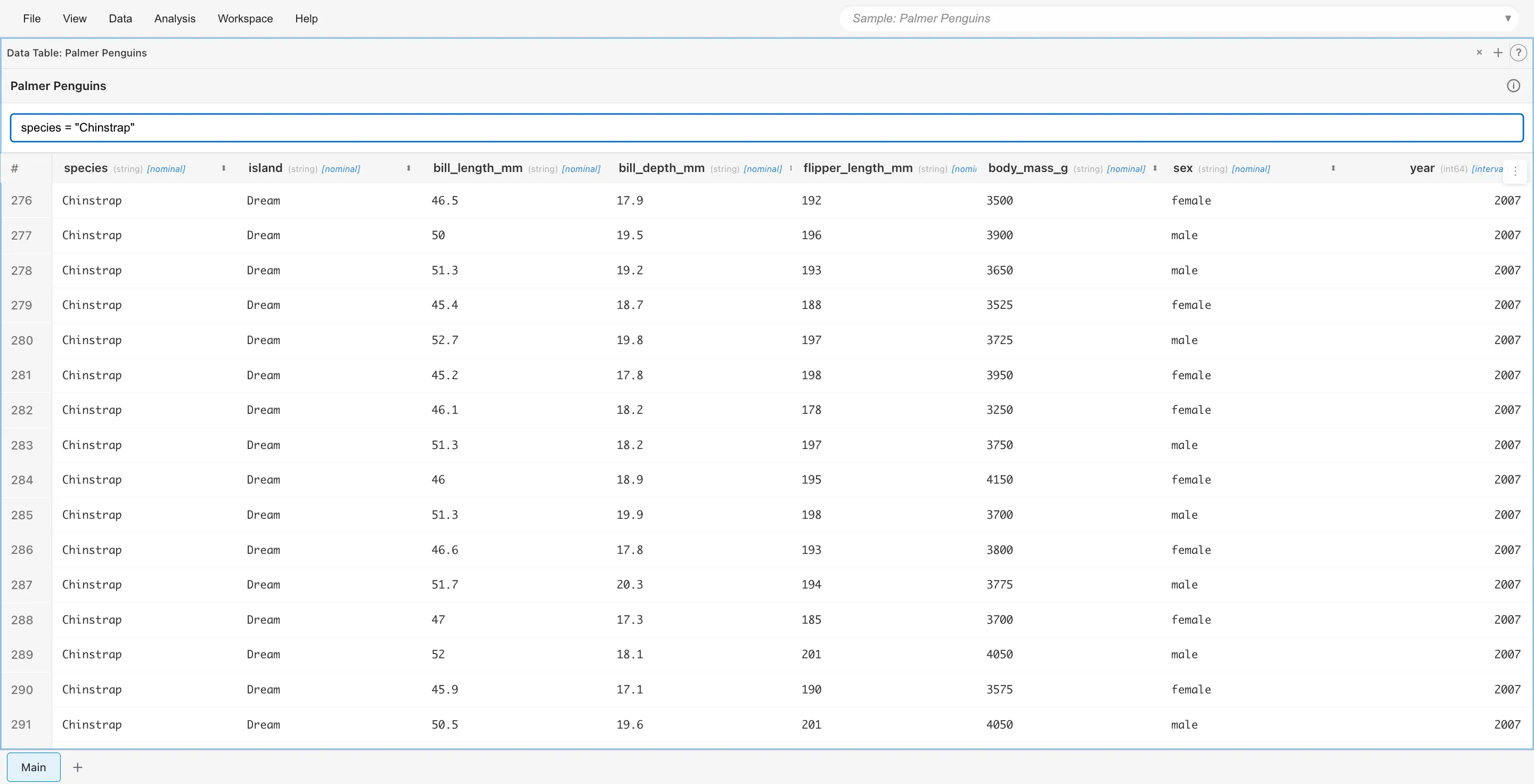
Filter Feature
Enter filter expressions to display only rows that match your conditions.
Basic Usage
- Enter an expression in the filter input field at the top of the Data Table tab
- Press Enter or click outside the input field
- Only rows matching the condition are displayed
How to Write Filter Expressions
Comparison Operators
| Operator | Meaning | Example |
|---|---|---|
= |
Equal to | species = 'Adelie' |
!= |
Not equal to | species != 'Adelie' |
> |
Greater than | age > 30 |
>= |
Greater or equal | age >= 30 |
< |
Less than | age < 30 |
<= |
Less or equal | age <= 30 |
Pattern Matching Operators
| Operator | Meaning | Example |
|---|---|---|
LIKE |
Matches pattern (case-sensitive) | name LIKE '%田%' |
ILIKE |
Matches pattern (case-insensitive) | name ILIKE '%Smith%' |
NOT LIKE |
Does not match pattern | name NOT LIKE '%test%' |
Pattern syntax:
%represents any string (0 or more characters)_represents any single character
Examples:
name LIKE '%田%'- Contains "田"name LIKE '山%'- Starts with "山"name LIKE '%郎'- Ends with "郎"email LIKE '%@example.com'- Ends with @example.com
Logical Operators
| Operator | Meaning | Example |
|---|---|---|
and |
And | age > 30 and sex = 'male' |
or |
Or | species = 'Adelie' or species = 'Gentoo' |
() |
Grouping | (age > 30 or salary > 50000) and active = true |
Set and Range Operators
| Operator | Meaning | Example |
|---|---|---|
IN (...) |
In list of values | species IN ('Adelie', 'Chinstrap') |
NOT IN (...) |
Not in list of values | status NOT IN ('deleted', 'archived') |
BETWEEN ... AND ... |
Within range (inclusive) | age BETWEEN 20 AND 30 |
NOT BETWEEN ... AND ... |
Outside range | age NOT BETWEEN 20 AND 30 |
Negation Operator
| Operator | Meaning | Example |
|---|---|---|
NOT (...) |
Negates condition | NOT (status = 'deleted') |
NULL Check and Boolean Values
| Syntax | Meaning | Example |
|---|---|---|
IS NULL |
Is missing value | bill_length_mm IS NULL |
IS NOT NULL |
Is not missing | bill_length_mm IS NOT NULL |
true / false |
Boolean values | active = true |
Column Names with Spaces or Special Characters
Enclose column names in double quotes (DuckDB SQL standard):
"Body Mass (g)" > 4000
Filter Examples
# Numeric condition
body_mass_g > 4000

# String condition (enclose in single quotes)
species = 'Chinstrap'

# Combining multiple conditions
species = 'Adelie' and body_mass_g > 3500

# Excluding missing values
bill_length_mm IS NOT NULL

# Pattern matching (partial match)
island LIKE '%Dream%'

# Matching multiple values
species IN ('Adelie', 'Gentoo')

# Range specification
body_mass_g BETWEEN 3500 AND 4500
Sort Feature
Click the sort button on a column header to sort data by that column.
Single Column Sort
- 1 click: Ascending order
- 2 clicks: Descending order
- 3 clicks: Remove sort
Multi-Column Sort
Hold Ctrl (Mac: Cmd) while clicking to sort by multiple columns.
- Ctrl+click: Add sort condition (ascending)
- Ctrl+click same column again: Change to descending
- Ctrl+click same column again: Remove sort for that column
During multi-column sort, priority numbers are displayed on sort buttons (e.g., 1, 2).
Row Selection
Selecting rows in the Data Table synchronizes the selection state with other tabs (Statistics, Graph Builder, etc.).
Selection Methods
- Single row: Click a row
- Range selection: Hold Shift while clicking
- Add to selection: Hold Ctrl (Mac: Cmd) while clicking
- Deselect: Click a selected row, or click an empty area
Integration with Other Tabs
Rows selected in the Data Table synchronize with other tabs:
- Statistics tab: Shows statistics for selected rows only (useful for comparison with overall data)
- Graph Builder: Selected rows are highlighted, allowing visual identification of specific data points
For example, you can select rows that appear to be outliers and examine them in the Statistics tab, or highlight only data meeting certain conditions on a graph.
Dataset Menu
Click the menu button at the right edge of column headers to access the following operations.
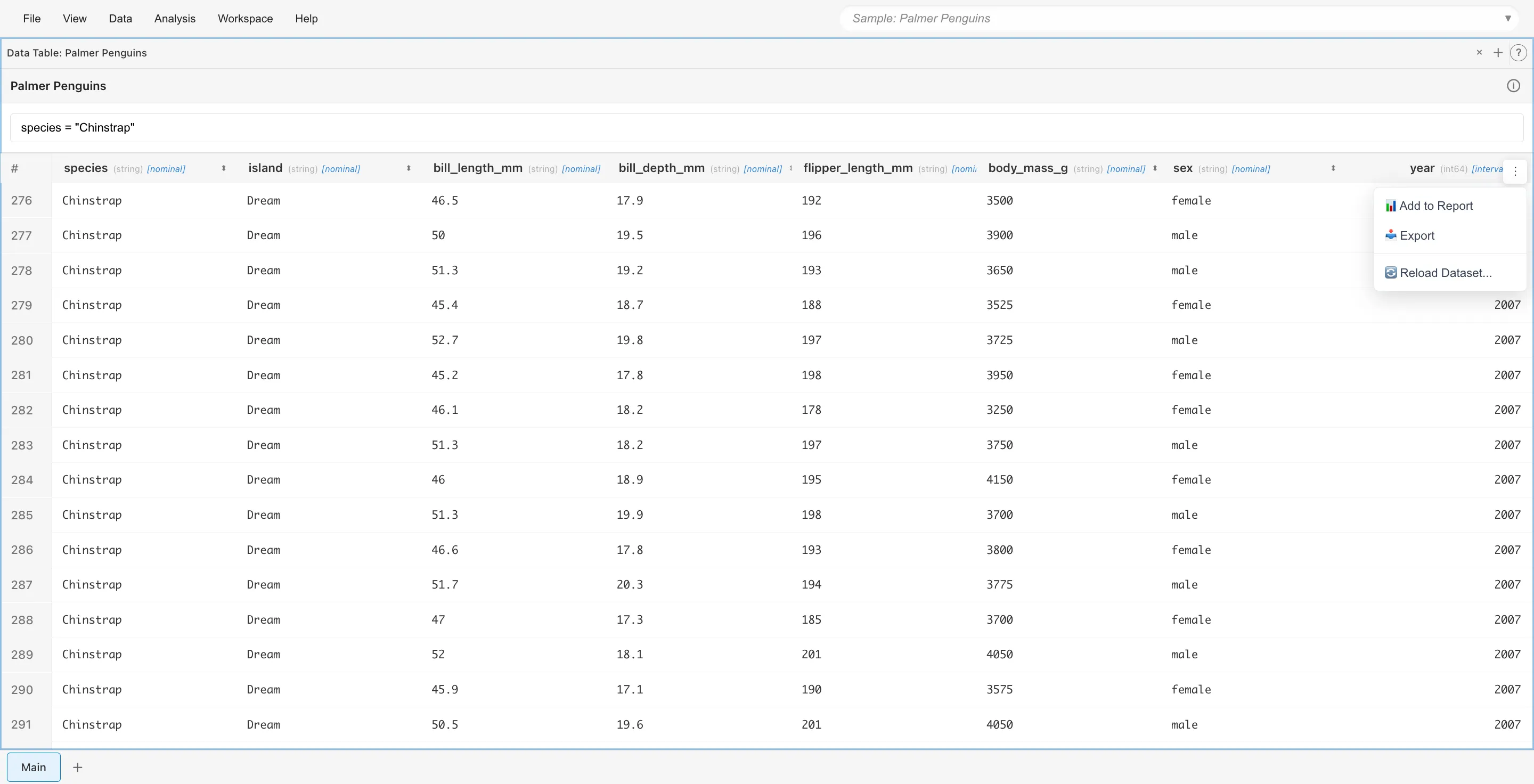
Metadata
View basic information about the dataset (dataset name, row and column counts, data type and measurement scale for each column).
Convert Column Types
Opens a tab for converting column data types. See Column Type Conversion for details.
Reload Dataset
Reloads data from the original CSV file. Use this to reflect changes after editing the file. This feature is only available for Primary datasets (directly loaded CSV files) and is not shown for derived datasets created in SQL Editor.
View SQL Query
For derived datasets created in SQL Editor, you can view the original SQL query.
Row Number Column
The leftmost column displays row numbers. These row numbers indicate the original data order and do not change when filters or sorting are applied.
Related Pages
- Data Preparation and Import - About data types and measurement scales
- Data Processing with SQL Editor - Data processing with SQL
- Basic Statistics - Viewing statistics for selected rows